
Adiós, Ecuador!
Puerto Misahuallí
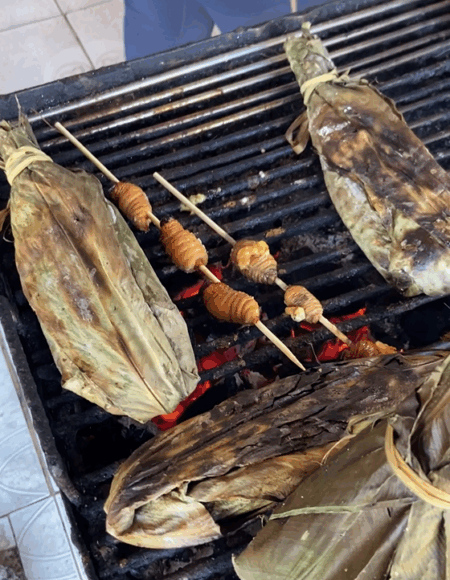
On a journey like this, sleep is scarce. The desire to keep going, even as our time in Ecuador draws to a close, is overwhelming. No one complains. By 7 a.m., we’re already in the jeep: through the rear-view mirror, I watch Baños de Agua Santa fade away for the last time (in this life!). We’ve only got 150 kilometres ahead of us, but Ecuadorian roads are often tricky. It takes us nearly four hours to cover this modest distance. We arrive in Puerto Misahuallí around lunchtime and stop for a couple of hours: we grab a bite, and some even dare to nibble grilled larvae of a plump, chubby insect. I’m not feeling that adventurous and make peace with my decision: larvae won’t be among the bizarre things I’ve eaten around the world.
In the centre of this small Ecuadorian town, not much happens. Monkeys drink from bottles left in bins. A few men watch a football match on what seems to be the only TV in the neighbourhood, crammed inside a shop that sells everything from nails to flip-flops. A few chickens wander distractedly along the edge of the main road.

So why come to Puerto Misahuallí?
The Rio Arajuno: A Journey to the Origin of the World
Because here we leave the jeep behind and board a canoe along the banks of the Rio Arajuno, a tributary of the Rio Napo, which in turn feeds into the Amazon River and flows between Ecuador and Peru. The waters of the Rio Napo originate at the foot of the Cotopaxi volcano, and (alas!) were the first to be discovered by Spanish conquistadors around 1540, when Pizarro and Francisco de Orellana explored them, always with the cross on their chest and the sword at their back, descending the currents all the way to the Atlantic.

Colonisation aside, travelling upriver feels like entering the heart of the Earth, returning to an ancestral story we all belong to. At Liana Lodge, we’re handed keys (useless, of course—there’s nothing to lock here) to what will be our home for the next few days: a bungalow with no glass windows, just endless mosquito nets (though we won’t see a single mosquito, thanks to the season), and a thatched roof made of toquilla straw (yes, the same used for Panama hats that aren’t actually from Panama—remember those?) towering 6–7 metres high, maybe even 10.

I don’t know it yet as I toss my backpack onto the bed, but the next morning we’ll see a group of monkeys walking across that roof, all serious, as if heading to school or the office. They won’t even acknowledge us, lying there on the bed. Just a fleeting, indifferent glance: we’re mere passing guests here.

As daylight fades into dusk, we board the same swift canoe that brought us here just hours earlier. Yet to me, time seems to crumble in this place as we travel upriver. The Amazon rainforest speaks to us, watches us: we’re surrounded by sounds, calls, songs of birds, crickets, cicadas, and probably other creatures I don’t recognise. I’m certain they’re watching us from the treetops. I think of Conrad’s Heart of Darkness. I know he wrote about Africa and I’m in Ecuador, but this hidden, noisy life isn’t just a natural backdrop: it’s a mystery, the unknown, a descent into the human soul. It’s primitive and eternal, a breathing place that precedes and outlasts human presence. It’s a journey to the origin of the world, a deliberate descent into the depths of the inner self.

We return to the lodge for dinner. There’s no electricity after 9 p.m. here. We dine by the light of a modest open-air fireplace and soon retreat to our rooms. I’ll never forget that night: the continuous concert of Pachamama distances me from the fragile modern society I’m used to and guides me into a deep sleep, filled with distant memories and invisible ties to the past.
Ferocious Ants, Exploding Trees, and Walking Palms
In the morning, our local guide takes us on a long walk through the forest. We move slowly and with great care. I wade into vegetation that’s hard to grasp, visually and mentally. It’s a vast green universe: from top to bottom and back again, reference points aren’t always clear. Everything is damp and alive. But here, we humans are fragile.

They say strength lies in unity, and with concha ants, that proverb takes on a unique meaning. These tiny killers can be lethal if a group bites you and you have heart issues. If just one attacks, you might get away with 24 hours of vomiting, diarrhoea, and fever. To look at them on the tree bark around us, they seem harmless, almost mundane. Which is why we should never judge by appearances.

One plant that makes its nature clear from both name and appearance is the Hura crepitans. Its branches rise distinctively up to 60 metres. Its wood is soft and fragile, unsuitable for construction. But its trunk is the real showstopper—up to 10–15 metres in circumference when mature, and in younger specimens, covered in long, sharp spines that make climbing nearly impossible. Hence the nickname “monkey-no-climb tree.” It has almost no leaves this time of year; those come during the rainy season (December–April), and thankfully no fruit either. Because Hura crepitans produces red flowers and round fruits that resemble pumpkins—and explode when ripe, launching seeds at over 200 km/h and up to 100 metres away. That’s why it’s also called the “dynamite tree.”
Naturally, its explosive and toxic traits have made it the subject of myths. One legend I wrote down in my notebook says the fruits explode to release trapped souls. Each seed is said to contain the memory of a fallen warrior, and the explosion is their battle cry. Some elders forbid collecting ripe fruits, fearing they’ll disturb the spirits.

The Socratea exorrhiza, on the other hand, doesn’t explode: it walks. Or rather, let’s be less poetic and more scientific. This palm develops long, sturdy aerial roots that extend from the trunk like legs. They resemble stilts or scaffolding, helping the tree shift or rise when needed. When the ground becomes unstable or the environment changes (less light, fewer nutrients), the plant grows new roots on one side and lets the opposite ones die off, slowly moving the trunk toward better conditions. It’s a slow process: just a few centimetres a day, sometimes up to 20 metres over several years. The idea that it “walks” is more legend than proven fact. The roots mainly stabilise the palm and allow it to grow tall without a thick trunk. It doesn’t move like an animal, but the legend (amplified by local guides) retains irresistible charm. It’s a stunning example of nature adaptation.
Chicha
I don’t like romanticising reality – because reality is 99% better than any book or film. So, I’ll get straight to the point: not everything goes smoothly on a trip, and not everything is perfect. Sometimes food isn’t fragrant or appetising. Chicha is one of those.
Let’s take a step back—what is chicha? It’s an important drink in Ecuador. A symbol of cultural identity, still representing a deep bond with indigenous traditions and Mother Earth. It’s a fermented beverage, made with maize, cassava/yuca (which looks a bit like a carrot), or fruit, depending on the region. Sometimes it replaces meals.
Teresa, a Kichwa woman under 60 and already a grandmother, offers me a glass in the pueblo (i.e. village) where we end our day. She looks at me warmly and hopefully as I sip a few drops. She smiles, and I smile back, though deep down I wish Pachamama would open up and swallow me whole. I know the preparation is artisanal, passed down through generations. I know it’s an ancient practice, and offering it is a sacred, communal gesture.
But I can’t stop thinking that in some communities, the maize is chewed by women to start fermentation via salivary enzymes. And in this pueblo, I don’t know if Teresa chewed the maize. The chicha is thick, slightly alcoholic, sour, and earthy. Teresa watches me, her face lined with wrinkles that make her look at least 15 years older. She smiles. I down the rest of the glass and pray for Pachamama to open beneath me. No luck: Mother Earth isn’t listening this time.

Latacunga
Returning to the sounds of society feels almost offensive: surreal to see cars, crisp packets, buildings, traffic lights – even after just a few days in the heart of the Amazon. Everything there felt so distant.

After picking up the jeep in Puerto Misahuallí, our first stop is Latacunga. It’s not memorable, just a waypoint between the Amazon and Quito, from where we’ll fly home. I only remember one thing about this town: the esoteric shops near the cemetery, where I buy absurd items: a magical home fragrance meant to increase travel opportunities; a shameful amount of incense supposedly helpful for love, money, sex, work, political relevance (not that I care about that); and an endless series of anti-evil-eye amulets, one for each month of the year, which I’ll distribute to loved ones back home. In the last shop, they even offer me a magical drink to cure heartbreak. I immediately think of the chicha from a few days ago. I politely decline and step out with my magical arsenal: with everything I’ve picked up along the way, I could be protected for the next fifteen years.
Laguna Quilotoa: Adiós, Ecuador!
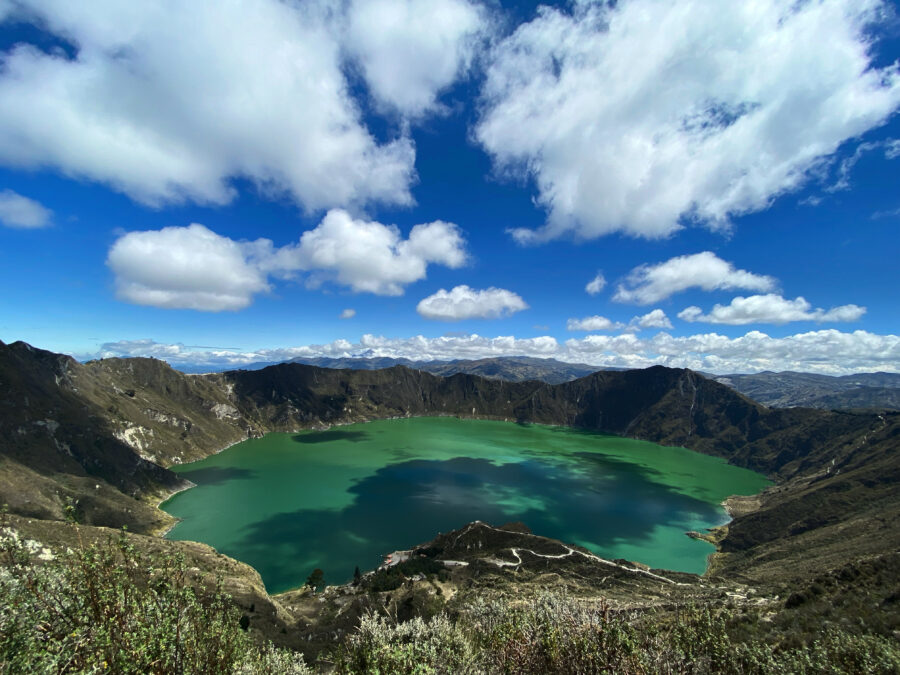
Before heading back to Quito, the final day in Ecuador turns out to be one of the most unforgettable. Laguna Quilotoa is, without doubt, one of the country’s most spectacular sights: a volcanic lake nestled within a caldera at over 3,900 metres above sea level, in the province of Cotopaxi. The crater’s circumference seems to stretch endlessly into the horizon, though I later discover it’s just three kilometres.
Two of my travel companions and I decide to hike down to the lake. Four hundred metres of elevation: how hard could it be? The descent takes about half an hour: there are stretches of fine sand and volcanic ash that make the footing unstable and slippery, and sections with stones and roots that demand attention and shoes with good grip. The climb back up takes an hour or more: it’s strenuous and at high altitude, so the oxygen is thinner.
The view, from both above and below, is worth every step. The light transforms the lake’s surface into a mosaic of hues ranging from turquoise to emerald green. Everything shifts constantly, as the wind plays with the clouds and the sun.
Standing before the lagoon, I gave my official adiós to this country. For me, Ecuador remains one of the most complete and unforgettable places I’ve visited in the world. It’s become an unreachable benchmark: between the Galápagos and the Andes, I found not only the beauty of the world, but also that part of myself that had been searching for a more authentic meaning in travel.
