
Berlin is pure chaos
At some point in your life, I hope someone invites you to Berlin. Say yes. Trust the chaos. Because Berlin is pure chaos: unpretentious, liberating, incoherent, ironic.
The following account stems from a long series of notes I’ve taken over the past few years, during which I’ve been fortunate enough to spend frequent short-to-medium stays in this metropolis. The scattered thoughts that compose it are not intended as a guide. They are memories, fragments of impressions, destinations and anecdotes—perhaps lesser-known—about this city.
What compelled me to write this mountain of words precisely on the anniversary of the fall of the Berlin Wall was the memory of a feeling: I was little when it happened, but in the years that followed—for a long time—I know I felt an immense opening towards the Other, a tide of unheard-of possibilities. Has the wind changed? Perhaps. The world in which the Wall fell certainly no longer exists. And perhaps what’s dictating this article now is a mix of melancholy and disappointment, but hope—as they say—is the last to die. These thoughts may well be an act of rebellion against the closing-in of the times we’re living through.
Berlin is unpretentious
Berlin—unlike other European capitals—is the opposite of ostentation and showy ambition. It presents itself as it is, with its virtues and its many, complex vulnerabilities: it knows full well it’s imperfect. It wears masks like everyone else, but it’s aware of them: sometimes it laughs at itself, sometimes it pretends not to notice. Berlin is all this and more: it is unpretentious, and those who are unpretentious are free. Free from the need to please, to persuade, to compete. It doesn’t seek approval. Berlin doesn’t give a damn what anyone thinks. It doesn’t measure itself against the standards of other cities, because it defies the very idea of being a singular city: over time, it has been broken, split in two, stitched back together.

From a past not so distant from mine, the tradition of the dacha still lingers. A remnant of East German (DDR) culture, these simple, functional little houses—used as second homes for leisure, gardening, and outdoor life—are no longer officially called dacha, but they’re still found, especially on the outskirts and in urban garden colonies (Kleingartenanlagen), family gardens (Schrebergärten), or areas known as Laubengärten (garden plots with huts). In many of these colonies, you can walk through the areas where the dacha are clustered: there are little lanes, sometimes ponds. You pass by fences marking where one property ends and another begins. You brush past well-tended gardens. In the warmer months, you can smell and hear the sizzle of summer barbecues. These personal refuges, used seasonally or even year-round (if the area’s rules allow), are common in East Berlin districts like Pankow and Lichtenberg, or in Treptow-Köpenick, a generally green borough with several Kleingartenanlagen along the River Spree. But the dacha colony dearest to me (due to its proximity to a friend’s home), though not very large, is in Rheingauviertel, a residential area in the Wilmersdorf district.

In a world that often rewards excess, remaining unpretentious—like the dacha in Berlin—is almost revolutionary. The dachas remind me that happiness can live in small spaces, that wealth isn’t always visible, and that care reveals itself in the humblest details. In my travel memories, these little houses are an invitation to shed appearances.
Berlin is liberating
In Berlin, I’ve always felt free. Not just comfortable, but deeply welcomed, as if the city were saying: “I’m here, just as I am. And you can be just as you are.” I’ve never felt judged or pre-judged, nor that subtle competitive tension that often creeps into large urban centres. Its streets seem open to every form of humanity, as if they were designed to contain differences, not erase them.
That doesn’t mean Berlin is perfect. On the contrary, its social issues are tangible, visible in its margins and contrasts. But what struck me is that, despite everything, the city is never intrusive. It doesn’t try to impress you, it doesn’t intimidate. It gives you space. I’ve often felt this in the way it reinvents spaces—often at a dramatic, disorienting pace—that were once meant for entirely different purposes.
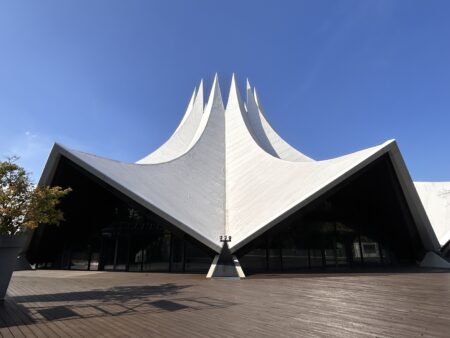
One such place is the Tempodrom, now home to the Liquidrom spa. From the outside, it looks like something out of a sci-fi novel: a geometric, visionary structure that resembles an abstract tent planted in the heart of Kreuzberg. Yet behind this futuristic architecture lies a different story: during the Second World War, the building was a railway station, and more recently, a spontaneous stage for street performers. Today, every trace of that past has been transformed. Inside, you enter a minimalist wellness world of clean lines and soft lighting. The Liquidrom offers saunas, pools and immaculate changing rooms, but its beating heart is the floating pool: a saltwater pool surrounded by concrete arches and immersed in music (from techno to house to classical).

Berlin is like that: it reinvents, makes space, liberates. In this sense, one of the places I’ve loved most during my various visits is the Friedrichswerdersche Kirche, another extraordinary example of architectural and functional reinvention: from neo-Gothic church to museum space, it embodies Berlin’s ability to transform the past into a place of living culture. In the heart of Berlin-Mitte, it was the city’s first neo-Gothic church, built in red brick as an alternative to the dominant classicism between 1824 and 1830. Karl Friedrich Schinkel, master of Prussian architecture, conceived the building as a stylistic and spiritual experiment, capable of engaging with medieval history and the modern needs of his time.

What makes the Friedrichswerdersche Kirche truly special today is its repurposing. After being deconsecrated and damaged during the Second World War, the church was restored and transformed into an exhibition space. The stained-glass windows, altar and central nave weren’t removed but integrated into the new use, creating a dialogue between the sacred and the secular—and certainly between past and present. Today it houses 19th-century sculptures from the Nationalgalerie collection, offering a unique context where art and architecture meet. I’ve seen many, many beautiful places on my travels. Places where I’ve felt welcomed. But when I walked into the Friedrichswerdersche Kirche, I felt like I was stepping into a painting. I felt a warmth that only Art can give. Wandering among those Nationalgalerie sculptures, it felt as though they were breathing with me through the centuries they came from.
Berlin is totally incoherent
Many travellers don’t like Berlin. They tend to perceive a military, masculine soul—an impression perhaps born of its history marked by wars, divisions, walls and functional reconstructions. Its buildings speak of pragmatism, necessity, scars. There’s none of the overrated architectural romance of Paris, nor the theatricality of Rome.
Some find it dirty and incoherent in terms of architecture. And they’re right: Berlin is the result of historical layers piled on top of one another. Neoclassical palaces coexist with Soviet blocks, industrial structures with contemporary glass cubes. It’s a city unafraid to show its contradictions.

The Bierpinsel, with its surreal shape and shifting past, perfectly embodies this tension. Not all visitors immediately grasp the reason behind its name. Yet a glance upwards at the 47-metre tower rising along one of Steglitz’s main arteries hints at the “brush” reference—Pinsel in German. The nickname emerged during construction, when the scaffolding resembled a shaving brush. Add to that its intended purpose: a venue for dining.
The name was cemented in 1976, when free beer was served at the opening, sealing the popular identity of the “beer brush”. The tower, made up of three floors, was designed by architects Ralf Schüler and Ursulina Schüler-Witte, the same duo behind Berlin’s ICC congress centre. Their original idea was to evoke the shape of an urban tree, but Berliners, with their direct and ironic spirit, immediately saw a shaving brush. The nickname spread quickly and still appears on signage on the structure.

From the outset, the Bierpinsel was intended as a hub for food and drink. Over the years it hosted restaurants, cafés, bars and even a nightclub, becoming an eccentric and lively landmark. However, after the last tenant—an art café—vacated in 2010, the tower stood empty, plagued by water damage and in need of major renovation. In 2021, the Bierpinsel was purchased by an investor aiming to revive it. The redevelopment plan includes office spaces and a return to dining on at least one floor. The reopening was scheduled for 2025, with the goal of restoring one of the city’s boldest and most iconic urban features. It hasn’t (yet) happened.
Another perfect example of Berlin’s lack of aesthetic and architectural coherence lies in the eastern district of Lichtenberg, among industrial buildings, residential blocks and traces of its socialist past. There stands the Dong Xuan Centre: a complex of six halls housing Germany’s largest Asian market. The name “Đồng Xuân” in Vietnamese means “spring meadow”. There are endless rows of grocery shops offering pungent spices, countless types of soy sauce, curry, rice, frog legs, noodles of every kind, tea, vegetables and authentic ingredients otherwise hard to find—all accompanied by what seems like an infinite Asian techno soundtrack. The restaurants and street food stalls serve Vietnamese, Chinese, Indian, Thai and Korean dishes. Alongside the food, you’ll find services and shops: hairdressers, tailors making bespoke garments, beauty salons, electronics stores, household goods. The fashion and accessories section is a jumble of traditional outfits, contemporary pieces—often counterfeit—lanterns, plastic flowers, jewellery for ceremonies unknown to me.

For me, it was an almost surreal experience. I arrived one late August evening, accompanied by a friend who’s hosted me in Berlin several times. On one hand, the sheer amount of plastic in most of the items for sale struck me deeply: I couldn’t help but think that, in the end, what we’ll leave behind will mostly be waste. On the other hand, the corridors and halls of what many affectionately call “Little Hanoi” form a true labyrinth of commercial activity that catapulted me hundreds of kilometres away from the heart of Europe. A journey within the journey.

You can’t talk about Berlin’s architectural eclecticism without mentioning Teufelsberg.
In 1930, this area on the outskirts of Berlin was little more than open fields, far from the city centre and shielded from prying eyes. Precisely because of its isolated location, the Nazi regime launched an ambitious project: the construction of a new university citadel, with cutting-edge faculties meant to represent Germany’s future. However, with the outbreak of the Second World War in 1940, the project was abandoned. After the war, what remained of the original complex was demolished, and the area was repurposed entirely: to receive the rubble of a destroyed Berlin. Every day, without pause, tonnes of debris were transported along Heerstraße and dumped here. Over twenty years, more than 26 million cubic metres of rubble were accumulated, transforming the site into the highest point in West Berlin. It was later covered with layers of sand and soil, and thousands of trees were planted to create a new forest.
From the early 1960s, and throughout the Cold War, the site’s strategic position attracted Allied interest. Thus was born Field Station Berlin, a listening and espionage station equipped with cutting-edge technology, capable of intercepting signals thousands of kilometres away. Its iconic white domes, still visible today, are its most recognisable symbol.
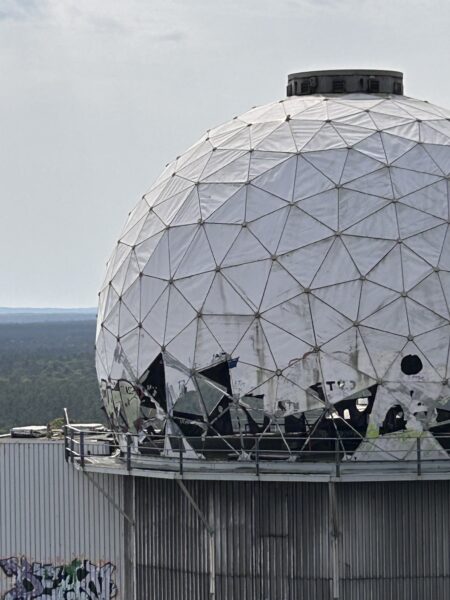
With the end of the Cold War, the station was dismantled and stripped of all equipment. After a brief stint as an observation tower for domestic flights, the building was abandoned. For thirty years, between private sales and unrealised projects (some visionary, others ethical), the site remained in limbo.
Today, Teufelsberg is considered a cultural asset of the city—not only for its layered history, but also for what it represents now: a free space, open to the creativity of people from all over the world, without constraints, without pretence, in the spirit of maximum expressive freedom.

Berlin is Ironic
Berlin’s history isn’t only made up of dramatic events that shaped its architecture. There are stories that reveal paradoxically amusing aspects of the city. Some call it karma.
Whoever designed the antenna at Alexanderplatz—affectionately known by Berliners as the “Telespargel”, or “television asparagus”, or simply Alex—didn’t anticipate a curious play of light that appears on sunny days. If you look up at the upper half of the metallic sphere atop the tower, you can clearly see a luminous cross, its sharpness varying with the intensity of the light and the angle of solar refraction.
For a socialist regime that had banned religion and demolished places of worship in the name of universal atheism, that cross was no trivial detail. The authorities reacted with embarrassment and irritation: they tried to alter the structure, treat the surface with special paints, erase the phenomenon. But nothing worked. According to some accounts, even the architect responsible for the project, Hermann Henselmann, was summoned and questioned by the Stasi to explain the incident.
For sceptics, the cross was merely a pretext to ridicule the Soviet regime. For believers, it was a divine sign—a kind of “heavenly punishment” inflicted on those who had tried to erase spirituality from public life. The phenomenon caused such a stir that it was dubbed by the media of the time “The Pope’s Revenge”—an ironic yet meaningful expression.
As often happens in the most embarrassing moments, efforts were made to turn the incident into a positive message. It’s said that an East Berlin official, observing the tower on a clear day, exclaimed with adaptive spirit: “It’s not a cross. It’s a plus sign. A positive sign for socialism!”
And so, even an accidental reflection became part of Berlin’s urban narrative: a city that never stops reinventing its symbols, even when they arise by chance.
Bonus tracks
I’ll end this long—perhaps far too long—article dedicated to Berlin with a few travel tips. Like those I’ve explored above, they reflect the city’s many souls:
- Have a coffee at the Café im Bode Museum | Museumscafés. Located inside the Bode Museum, one of Berlin’s most iconic venues, the café sits beneath the museum’s majestic dome. Trust me. If you love writing, this café is a small observatory: among tourists, students, art and architecture enthusiasts, every table can become the starting point for a new story.

- Berlin is a city that for many years was split in two: this summer I booked the M tour “Under the Berlin Wall” with two friends. Offered by Berliner Unterwelten, it’s an intense and well-documented experience that takes you into the escape tunnels dug beneath the Wall, where history, fear, courage and human ingenuity intertwined in extraordinary ways. The tour recounts the stories of those who, between 1961 and 1982, attempted to flee the GDR by digging tunnels under the Berlin Wall. During those years, over 75 escape tunnels were built, but only 19 succeeded: through them, more than 300 people reached West Berlin [Info Berliner Unterwelten- Berliner Unterwelten]
- Talking about Konnopke’s Imbiss means telling Berlin’s story through one of its most authentic gastronomic and cultural symbols: the Currywurst. Founded by Max Konnopke, a sausage vendor, the kiosk was born beneath the U2 viaduct at Schönhauser Allee, in the Prenzlauer Berg district. It’s considered the first East Berlin stand to serve Currywurst, starting in 1960. During the Cold War, it became a local landmark, a symbol of resilience and everyday life in a divided city. [Info Konnopke’s Imbiss – Das Currywurst-Original in Berlin seit 1930]
- The ruins of the Franziskaner Klosterkirche are now a war memorial and a metaphor for what remains, what transforms, what endures. Founded in 1271 by Franciscan friars, the church was the first building in Berlin constructed entirely of brick, marking the beginning of Backsteingotik (brick Gothic) in the region. It’s considered the last visible testimony of medieval monastic culture in Berlin. Severely damaged during the Second World War, the church was never rebuilt, but since 2016 it has become a venue for cultural events and contemporary art exhibitions. [Info Franziskaner-Klosterkirche – Berlin.de]

So wonderful… you can feel the moment in every word. You are always welcome! Thank you.
Vielen Dank, my friend 🙂 We already have new ideas to explore it in 2026, so it’s just a matter of deciding when 🙂
Despite your intriguing article, I will never love Berlin, for various reasons you know about. But that doesn’t mean that I won’t go there again to explore the places you write so vividly about I will bring my writer husband to the café and leave him there for some hours while I hit the spa. Like with foods one doesn’t like, we must keep tasting them, because taste changes over time.
I was hoping to receive your comments, because I’m aware of your complicated relationship with Berlin 🙂 so thank you for taking the time and read and leave your thoughts here. If your Berlin taste ever changes, it would be interesting to know. (The comment about leaving your husband at the café and you going to the spa made me chuckle).