
Marseille
 A second chance
I have often felt at home in places that were not home, in locations sometimes close by, sometimes many latitudes away from my flat. It sounds like a cliché, a slightly pretentious phrase, the kind of thing you see on Instagram or TikTok, where we convey a performative life and where many share sugar-coated experiences.
In Marseille, however, that’s exactly how it was for me: I felt at ease almost immediately (apart from a moment of confusion at the station, when a police patrol passed me by chasing what turned out to be a robber, but then again, where doesn’t something like that happen in this cruel world, overburdened by “Others” who come here and steal our jobs, take our women away, etc., etc.). . As I was saying, facing the Mediterranean, I felt at ease almost immediately, and I often had the feeling that I had already walked its streets, that I had already bought bread in one of its many boulangeries.
Yet, before leaving, I met many people who advised me against going to Marseille. Surprisingly, most of them had never even been there, but obviously full of clichés and preconceptions based on nothing, they felt compelled to inform me that no, there is nothing in Marseille, Marseille is criminal, dirty, dangerous.
However, given that there is nothing more dangerous than hearsay, I spent a few days in Marseille and that is how this little treatise in defence of one of Europe’s most misunderstood cities came about. Because Marseille, like Cairo, Naples, Genoa, Delhi, Sarajevo, Detroit, have often been discarded and mistreated destinations in the collective imagination, but only destinations like these have allowed me to put together second chances on these virtual pages. And there is nothing more glorious, more human, in this world than a second chance.
That light that is already the South, that is already the Mediterranean
Marseille is a multitude. Its neighbourhoods mix different times, languages, architectures, music, scents, faiths, follies, foods and hardships. In its streets, a distinctly French imprint overlaps and is lost, dissolving and merging inexorably with other cultures, in that light that everyone ends up talking about when they describe it, that light that is already the South, that is already the Mediterranean.
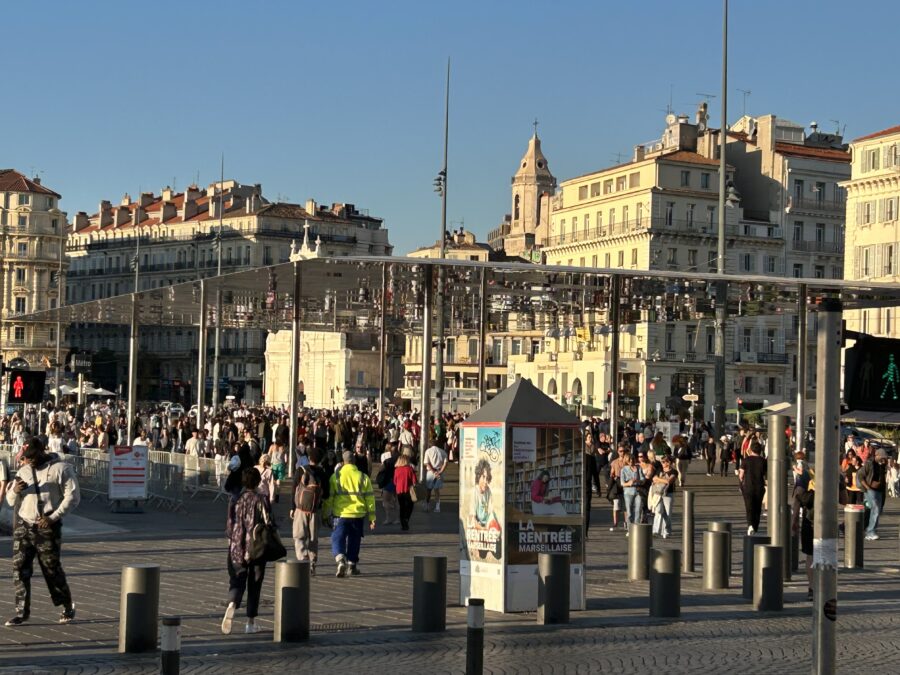
And in this light, I walked everywhere, even though Marseille is the second most populous city in France. And I walked everywhere without being distracted by the crowds that, in other months of the year or on different days of the week, would have been spewed onto my path or onto its avenues by the cruise ships that include this city in their itineraries.
Obviously, if this hadn’t been the case, my travel experience would have been completely different: at each stop on the cruise, passengers are only given a few hours to spend in each city, causing sudden floods of tourists, especially in the historic centres, always in the same places, always and only in the main attractions.

Marseille is not a tourist city
And everywhere I went, with the exception of the Le Panier district, which is as fake as it gets, I met a real city, made up of people who still take their dogs out to pee, crazy people who shout at traffic lights, folks who smoke on their balconies, groups of friends who go out for dinner, and local markets where once and again I couldn’t tell when an avocado was good or not. I found myself on that merry-go-round that starts up again every day, vibrant, problematic, multi-faceted. I saw laundry hanging on balconies, with bras and underwear sometimes thrown crookedly on the line, ready to be blown away by a gust of wind to the Camargue. On one of my first afternoons in Marseille, I came across a Kurdish demonstration passing by a chess tournament organised by the city for Science Month: flags and chessboards, just a few metres apart.

Along Boulevard Vauban, I watched a couple of tailors sewing, altering and repairing a pair of trousers and a skirt, and fixing a zip. If you’re interested, they’re open from Monday to Saturday. In front of Boucherie Maraval, a young man arrived on a slightly battered white Vespa and shouted his takeaway order from his white speed machine.
 At the tables of Bar de L’Est Chez Momo, on Rue du Marché des Capucins, the whole world was sitting: a group of friends in their eighties, an Asian couple, a woman with obvious gout scars, a young intellectual with the inevitable round John Lennon glasses, some drinking beer, others lemonade (which in France is often like Sprite even if the bottle says it’s artisanal), some smoking, others getting up to greet a friend. And all around, a series of hammams, kebab shops, shops selling African cosmetics, a few mosques, all along the street dedicated to Capuchin monks.
These wide-open horizons that merge together in my mind and in the notes I took while I was in Marseille smell of aniseed, of Pastis, an aperitif that, although now found throughout the rest of the country and in Italy, was created right here in the early 1900s when it was decided to abolish absinthe and an alternative drink was sought. Diluted in cold water, ice is added at the end, causing the liqueur to change colour.
Next to the glass of Ricard is a plate of hot paninesses fris, chickpea flour mixed with water and cooked until thickened, then fried in olive oil, and a few fried sardines. People come and go in this bar, whose name and address I have not written down, but which is tucked away on the corner of a building near the Musée des Civilisations d’Europe et de la Méditerranée: a couple arrives with a pretty little girl who is learning to walk, and then two young people come in and greet the owner with a hug. I haven’t written down this person’s name either, who knows why.
The crowd-world that is Marseille never stops, and I feel right at home amid all these intersecting lives.
La Cité Radieuse: building community, building unity.
In my books, on Instagram, and on this blog, I have often written about housing and social utopias. Visiting la Cité Radieuse was part of my travel plans during the pandemic: at that moment in history that now seems so distant and disturbing, whose collective drama we seem to want to forget, and in which mobility and socialising were totally compromised, I promised myself that at some point, once that nightmare that ultimately made us perhaps tougher and more isolated was over, I would come to Marseille to visit this vertical community, designed for living, working and meeting.
And since I joke about everything except travel, I finally arrived at what its creator, Le Corbusier, had initially called a machine for living. Standing in front of its entrance, I am reminded of various descriptions related to cohabitation, sharing everyday life and socialising. Creating is composing, it is putting one’s sensitivity into rhythm, it is forming a body, it is creating unity. Have we learned this in these dystopian years? Standing in front of the Modulor (the system of proportions based on the measurements of the human body, designed by Le Corbusier to create harmonious and functional spaces, whose 1.83-metre-tall silhouette is still visible at the base of the building), I cannot find an adequate answer to this big question.

With its 18 floors and over 300 flats in 23 different layouts, the exposed concrete complex of the Cité Radieuse sought to revolutionise city living: shared spaces, a school, a hotel, a restaurant, rues intérieures (don’t dare call them corridors) with shops, a roof garden with a gym, a nursery, and even an open-air theatre, all in a single building, every detail designed to ensure the well-being of the tenants, in perfect orientation. Air, sun, light, and running water. A vertical city from which it is virtually possible never to leave.
What passers-by called “la maison du fada” (“the madman’s house”) when it opened is located at 280 Boulevard Michelet, in the 8th arrondissement. I wonder if the people of Marseille have got used to this strange, brightly coloured concrete building in the meantime. Some of the tenants who arrived in 1952 still live here. In fact, I meet many people coming and going in this building, with keys in hand, shopping bags in tow, in the lifts. Few greet me, but it seems to me that their smiles are perfunctory. I feel as if they are sizing me up. And then I think of the words of James Graham Ballard, one of my favourite dystopian writers: “In a way, life in the skyscraper had begun to resemble the outside world: there was the same ruthlessness and aggression hidden behind a set of polite conventions”. Because the commercial spaces have been reduced to a few shops, and the rooftop gym is now home to an arts foundation. The grass in the garden on the ground floor is dry and yellow, even though it is early October and the temperatures are still pleasant.

The city seems to be encroaching ever closer on the building. I wish I had the courage to stop those who still live here: in the lobby there are lists of names of professionals, architects, designers, doctors, fashionable people. I don’t have definitive answers to all the questions dancing around in my head in the building: why are there balconies with nets? And aren’t those balconies a little too low? And do the people who live here really meet each other? Are social events organised that bring the tenants closer to the idea of intimacy desired by Le Corbusier?
Perhaps those who have remained simply want to live and work within a myth, within a utopia that hoped to give the working class the means to combat the alienation of modern life. Or perhaps it is an immense, fascinating paradox: in a building like this, where the flats are clinging to each other like the cogs of a clock, unthinkable without each other, each tenant has managed to carve out a little piece of privacy.

Cours Ju, where I bought a heart
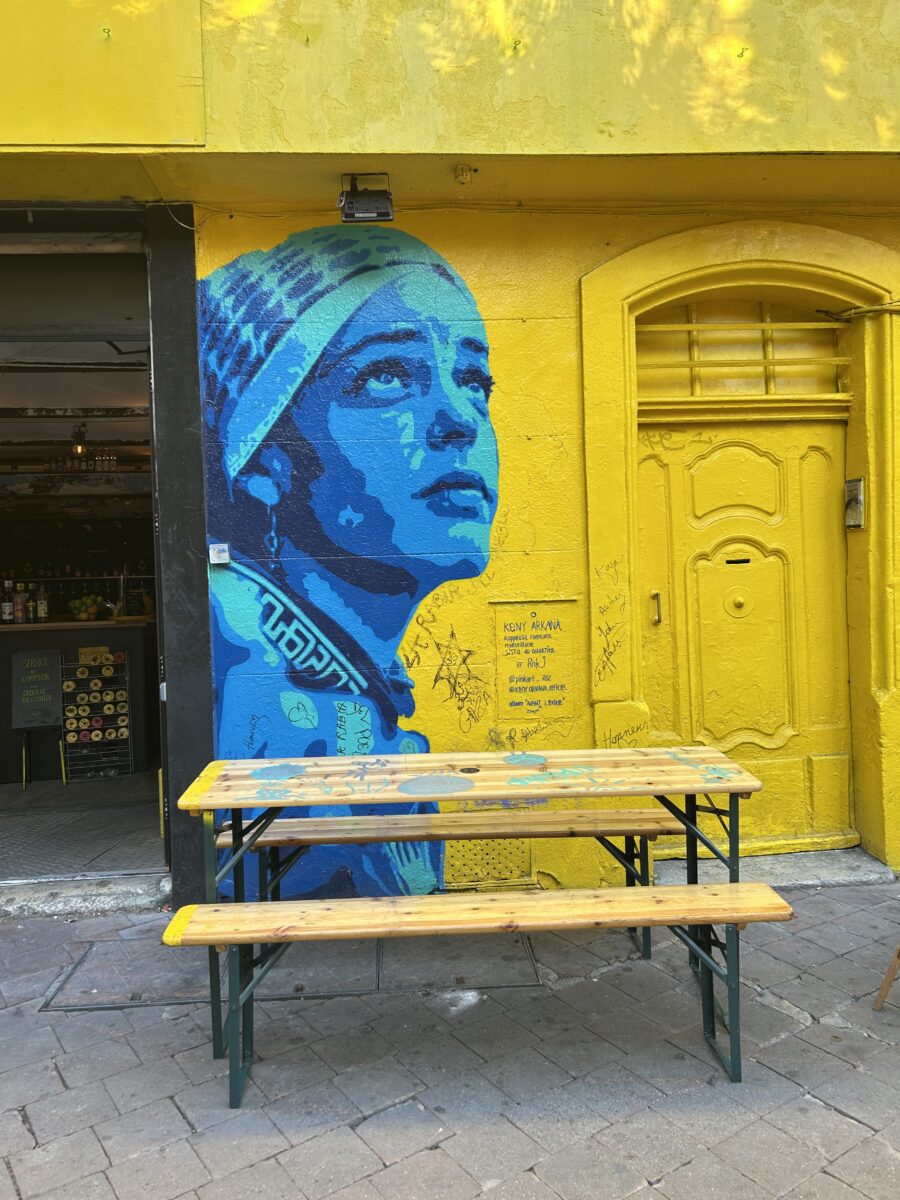
Cours Julien, or Cours Ju as the people of Marseille call it, explodes before my eyes. The fountains, buildings and shop shutters that enliven it are covered with a cheerful array of urban art: some praise anti-fascism; others tell stories of local figures such as Keny Arkana, a French-Argentinian rapper Keny Arkana who is active in the left-wing movement “La Rage du Peuple”, created in Noailles, a neighbourhood in the city centre; still others talk about the MTP, the iconic group of supporters of the Olympique de Marseille football team.
It is not only the southern light that warms my shoulders as I sit at one of the many bars on this street and order a beer: around me, there are lots of groups of friends and families and travellers passing through. They chat fervently, who knows how many stories and how much gossip is exchanged around these tables, some eating something, others simply enjoying the comfortable temperatures of this late afternoon in early October in their short sleeves.
In the past, however, Cours Ju served another purpose: it was the beating heart of Marseille, as the site of the wholesale and retail fruit and vegetable market. For a long time, it was the belly of the city: farmers from the surrounding towns and villages came here to unload their produce in the wholesalers’ warehouses and in the open air. At the end of the 20th century, among them were the partisanes, or semi-wholesalers: they acted as commercial intermediaries, reselling goods purchased from wholesalers at retail prices. At that time, they accounted for about 65% of the traffic on the Cours Ju market. Between the 1960s and the mid-1970s, the city of Marseille decided to relocate all wholesale fruit and vegetable trading to a single site in the Arnavaux district to decongest the city centre and Cours Ju. I think of the rumours that must have been circulating in this part of Marseille before everything was moved to this new commercial hub. I imagine the constant haggling, the shouting, the handshakes.
I am lost in these thoughts as I arrive in front of the window of a second-hand shop. At first, I don’t understand what I’m looking at: there are countless items on display, piled on top of each other, a hammer resting on a painting, which in turn is balancing a plastic banana and an iron, and then a vase full of peacock feathers, a series of erotic comics, and a trunk overflowing with things I can’t even make out. On top of all this is a heart. Anatomically correct, with the aorta and everything else, fiery red, pure plastic. For me, that shop window is the perfect metaphor for both Marseille and life: both are a big mess, with voices and faces changing at every corner, with problems and opportunities arising every time the wind changes. Above all, despite everything, and never more so than at this moment in history, there should be heart: understanding, some kind of tolerance, joy and passion.
I enter this shop, which looks like a blender in action. I buy the heart. I bought a heart at Cours Ju. It never hurts to have two.
